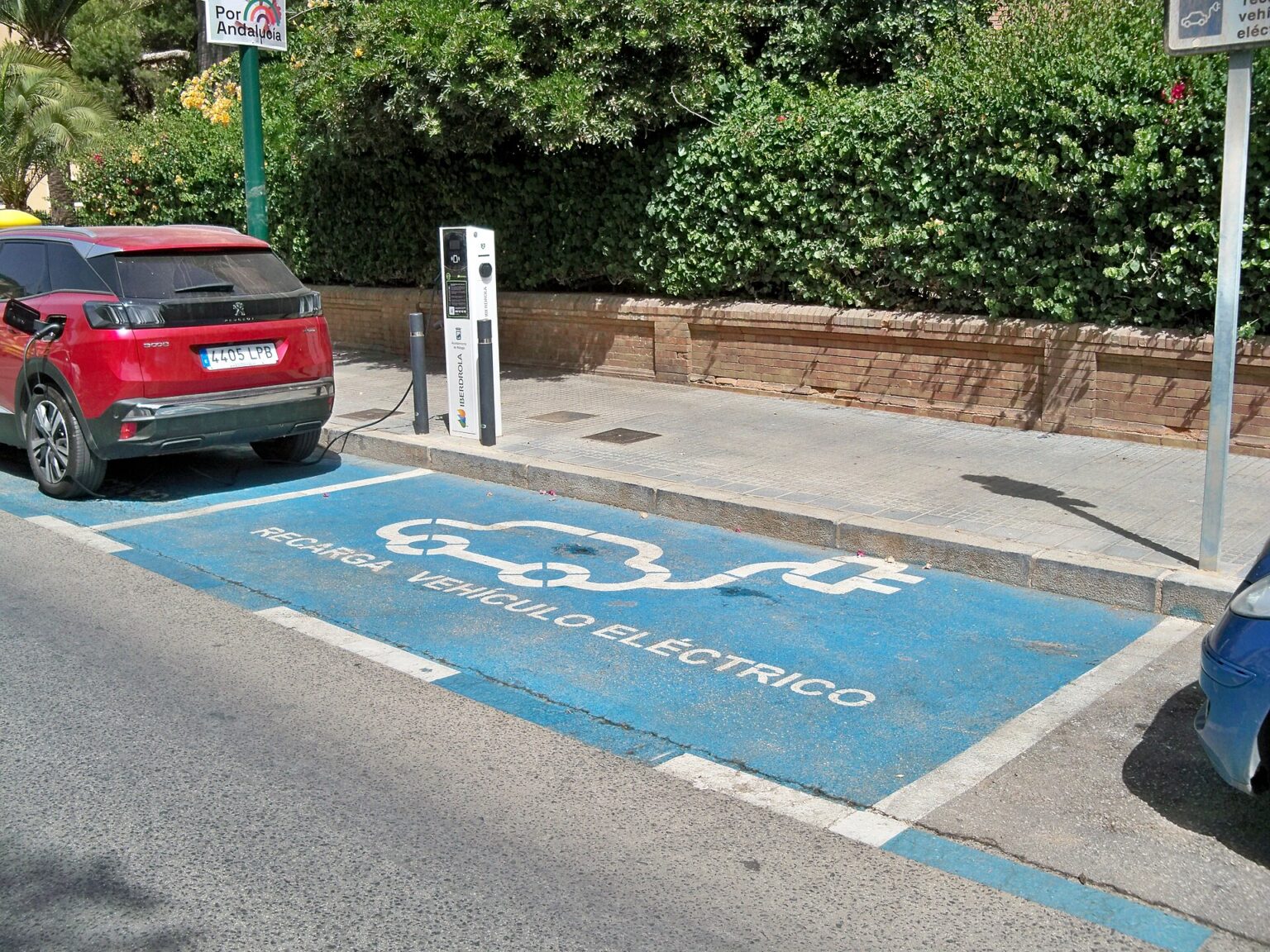

How many chargers Málaga has
Counts vary with the source, but they all point the same way. A live tracker listed 399 public charging points at 127 locations in Málaga on 14 November 2026, run by ten operators, with Iberdrola holding just over half of them (ChargeInsights). A daily price tracker counted 308 points on 11 November, of which 88 were in use at the time of its snapshot (coches-electricos.org).
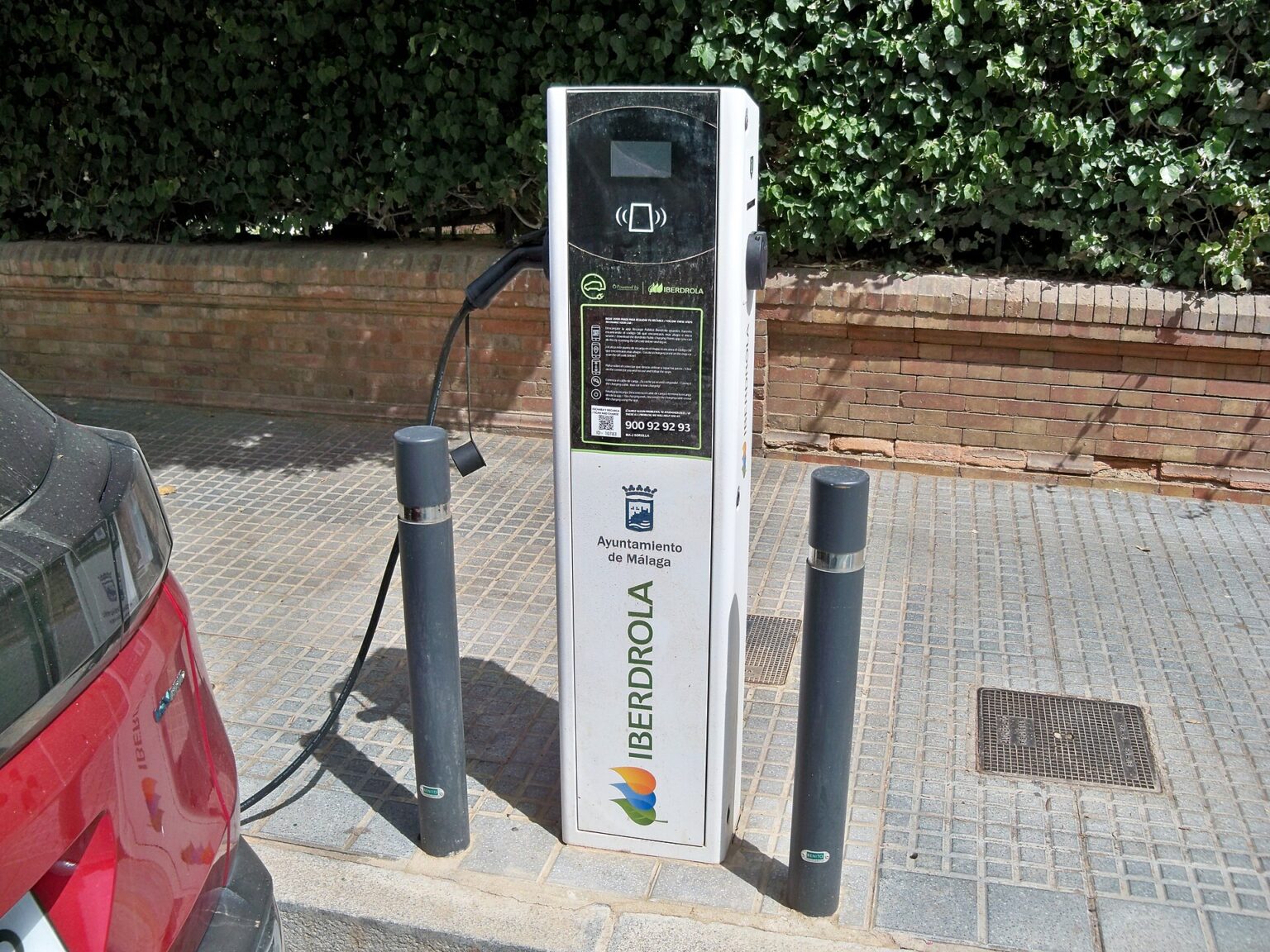
Part of that network belongs to the city. In March 2026 the Ayuntamiento extended Iberdrola’s concession for the municipal street chargers by five years: 35 units at 31 locations spread across all 11 districts, from the Paseo de la Farola to the Carretera de Coín, Pacífico and Carlos Haya (La Opinión de Málaga).

Fast chargers and what a charge costs
Most points in the city are slower AC chargers (up to 22 kW), which suit a hotel stop or a long lunch. About 30% are DC fast chargers, and 44 points deliver 150 kW or more. Among the biggest sites are Wenea’s hub on Calle Marea Baja, with 20 points of up to 360 kW, and the Tesla Supercharger at the Plaza Mayor shopping centre, with 12 points of up to 250 kW (ChargeInsights).
Prices depend on the operator and the charging speed. In the 11 November snapshot, tariffs in Málaga ran from €0.30 to €0.68 per kWh. Iberdrola, the largest network, charged between €0.42 and €0.68, Repsol between €0.36 and €0.48, and Plenoil’s two points €0.30 (coches-electricos.org). As a rough guide, adding 40 kWh at €0.50 per kWh costs €20. Compare that with today’s petrol and diesel prices in our November fuel guide.
Paying without an app
Visitors used to worry about needing a separate account for every network. EU rules have changed that. Under the Alternative Fuels Infrastructure Regulation (AFIR), operators of public charging points must let you charge “ad hoc”, without registering or signing a contract, and charging points installed since 13 April 2024 must accept a widely used electronic payment method (Regulation (EU) 2023/1804).
From 1 January 2027, every public charger of 50 kW or more along the main TEN-T road network must also have a bank card reader or a contactless reader, including older units (summary of AFIR articles 5 and 20). Until then, some older points still expect an app or a QR code, so keep your phone charged and data on.
To see which chargers are free right now, use Reve, Spain’s official charging map. It shows each point’s location, connector, power, price and real-time status for most fast chargers.
Parking an electric car in Málaga
One perk has gone. Since 1 January 2026, electric cars pay the same as any other car in Málaga’s blue-zone street parking (SARE): €0.50 for 30 minutes, €1 for an hour and a maximum of €2.50. The zone operates 9:00–14:00 and 16:00–20:00 on weekdays and 9:00–14:00 on Saturdays. Sundays and public holidays are free (coches-electricos.org).
Registered electric vehicles still get 45 free minutes in the municipal SMASSA car parks, but only with the required registration and proximity card, so this mainly helps residents (coches-electricos.org). Electric cars carry the DGT “CERO” label and can enter the city’s low emission zone. Our guide to the Málaga low emission zone explains the latest on fines.
By car
Most day trips fit easily into one charge. From central Málaga it is about 61 km (around 50 minutes) to Marbella, 104 km (around 1 hour 45 minutes) to Ronda and 126 km (around 1 hour 40 minutes) to Granada. These are approximate OSRM estimates. Mountain roads, such as the climb to Ronda or up to Sierra Nevada, use more energy than the flat coast, and cold weather can reduce range.
Before you leave, check the chargers at your destination on Reve and plan a backup, because a single charger in a small village can be busy or out of service. With a bit of planning, an electric car is a quiet and cheap way to explore the coast. If you need a car for your trip, ENZO Mobility is happy to help.